Latticeonirik
Luma Set
Luma Set
1. Problem Statement
After becoming familiar with classes, methods, and collections, learners often encounter new questions about organizing programs containing multiple interacting objects. Developing these structures requires an understanding of how responsibilities are distributed between classes and how relationships between their elements are established. Without knowledge of inheritance, interfaces, and polymorphism, analyzing programming constructions where several objects perform similar operations through different implementations can be challenging. Additional difficulties may arise when choosing between composition, inheritance, and separate abstractions for organizing reusable logic. Further C# study benefits from examining these mechanisms through structured explanations and examples demonstrating how they interact.
2. Solution
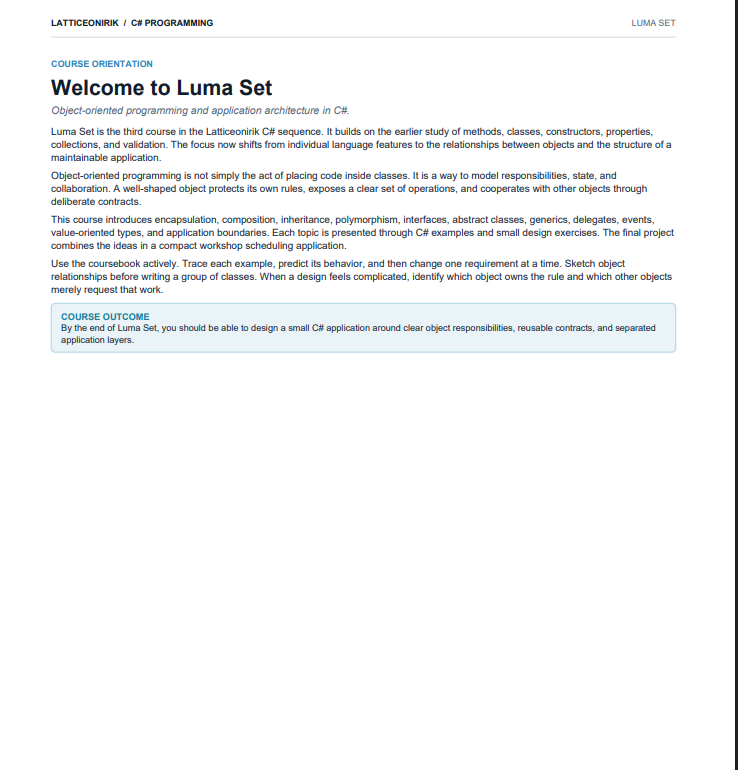
Luma Set presents a structured study of object-oriented C# constructions and the principles of organizing programming components. The educational materials explain how to create class hierarchies, define interfaces, apply polymorphism, and manage the internal states of objects. Separate sections examine abstract classes, composition, generic types, and foundational approaches to distributing responsibilities across program components. Practical exercises invite learners to analyze object behavior, compare code organization approaches, and create small interconnected structures. This approach supports a systematic understanding of how individual C# elements can work together within a programming model.
3. What's Inside
Module 1: Object-Oriented Programming Foundations
Review object-oriented programming principles and the roles of classes and objects within C# structures.
Module 2: Encapsulation and Object State
Study encapsulation, internal object data management, and the use of visibility modifiers.
Module 3: Class Inheritance
Examine inheritance, the creation of derived classes, and the reuse of behavior defined in base structures.
Module 4: Polymorphism in C#
Explore polymorphism and approaches to implementing different behaviors through shared programming constructs.
Module 5: Abstract Classes and Methods
Learn about abstract classes, abstract methods, and their application in defining common structures.
Module 6: Working with Interfaces
Study interfaces, behavior contracts, and the implementation of shared operations across different classes.
Module 7: Composition and Object Relationships
Examine composition, relationships between objects, and approaches to organizing their interactions.
Module 8: Method Overloading and Overriding
Compare method overloading and overriding through examples illustrating how both constructions operate.
Module 9: Generic Types and Methods
Explore the introductory principles of generic types and methods for working with different data structures.
Module 10: Classes, Structures, and Records
Compare classes, structures, and records while examining differences between reference and value semantics.
Module 11: Object Initialization and Validation
Study object initialization, property value validation, and the maintenance of consistent internal states.
Module 12: Exception Handling in Object Structures
Examine exception handling during interactions between methods and classes, including the distribution of error-handling responsibilities.
Module 13: Organizing Responsibilities Between Classes
Explore how programming responsibilities can be distributed among classes to create understandable structures.
Module 14: Applied Object-Oriented Project
Practice modeling a small record-management system using interfaces, classes, collections, and composition.
4. Who Is This For?
✅ Suitable if you:
- Already understand basic C# syntax, methods, classes, and foundational collections.
- Want to explore object-oriented approaches to program organization in greater detail.
- Are interested in inheritance, polymorphism, interfaces, and abstract classes.
- Would like to understand object interactions and the distribution of responsibilities.
- Want to learn how to compare different approaches to constructing programming structures.
- Enjoy working with code examples, diagrams, and exercises for independent analysis.
- Prefer structured written explanations of technical concepts.
❌ Not for you if you:
- Are beginning programming studies and have not yet explored fundamental C# constructions.
- Want materials focused exclusively on variables, operators, and introductory loops.
- Need an extensive examination of complex distributed systems.
- Are interested only in specialized algorithms for processing large datasets.
- Prefer individual instructor-led instruction rather than independent written educational materials.
- Expect a complete study of large application architecture without first examining object interaction principles.
5. What You'll Learn
Throughout Luma Set, you will examine the following concepts and practical skills:
- Encapsulation: Organizing internal object states and controlling interactions with object data.
- Inheritance: Constructing class hierarchies and reusing shared behavior.
- Polymorphism: Implementing different behaviors through common types.
- Abstract Classes: Defining foundational structures and methods for derived implementations.
- Interfaces: Creating contracts that describe programming component operations.
- Composition: Combining separate objects into interconnected programming models.
- Method Overloading: Creating multiple method variations with different parameters.
- Method Overriding: Defining specialized implementations of inherited operations.
- Generic Types: Using parameterized structures with different data types.
- Data Structures: Understanding distinctions between classes, structures, and records.
- Object Initialization: Creating objects with defined initial values.
- State Validation: Applying conditions to maintain consistent object data.
- Exception Handling: Examining error conditions and the principles of handling exceptions.
- Responsibility Distribution: Organizing classes according to the roles of individual components.
- Structural Modeling: Creating a small system where several objects perform interconnected operations.
6. Refund Terms
Refund conditions for Luma Set are governed by the published Latticeonirik store policy. Refund requests submitted within 14 days are reviewed according to the published terms, the delivery conditions of digital educational materials, and applicable legislation. We recommend reviewing the complete refund policy before placing an order.
7. Certificates
Luma Set — Upon completing Luma Set, we provide a certificate documenting your completion of the C# object-oriented programming curriculum.
Self-paced learning overview
- 📄 Digital file available after purchase
- 📚 Long-term availability
- 🔒 Secure checkout
- 📅 Content updated in 2026
Couldn't load pickup availability
What Format Are Latticeonirik Courses Provided In?
What Format Are Latticeonirik Courses Provided In?
Our courses are presented as written PDF educational materials. They contain thematic sections, explanations of C# concepts, programming code examples, and practical exercises. Each course follows a structure appropriate to its subject matter and intended learning stage.
How Do the Courses in the Collection Differ?
How Do the Courses in the Collection Differ?
Each Latticeonirik course focuses on a distinct group of topics and learning activities. Introductory sections examine C# fundamentals, while subsequent materials gradually move toward data handling, object structures, programming logic, and code organization. The specific curriculum of each course is outlined in its description.
Share