Latticeonirik
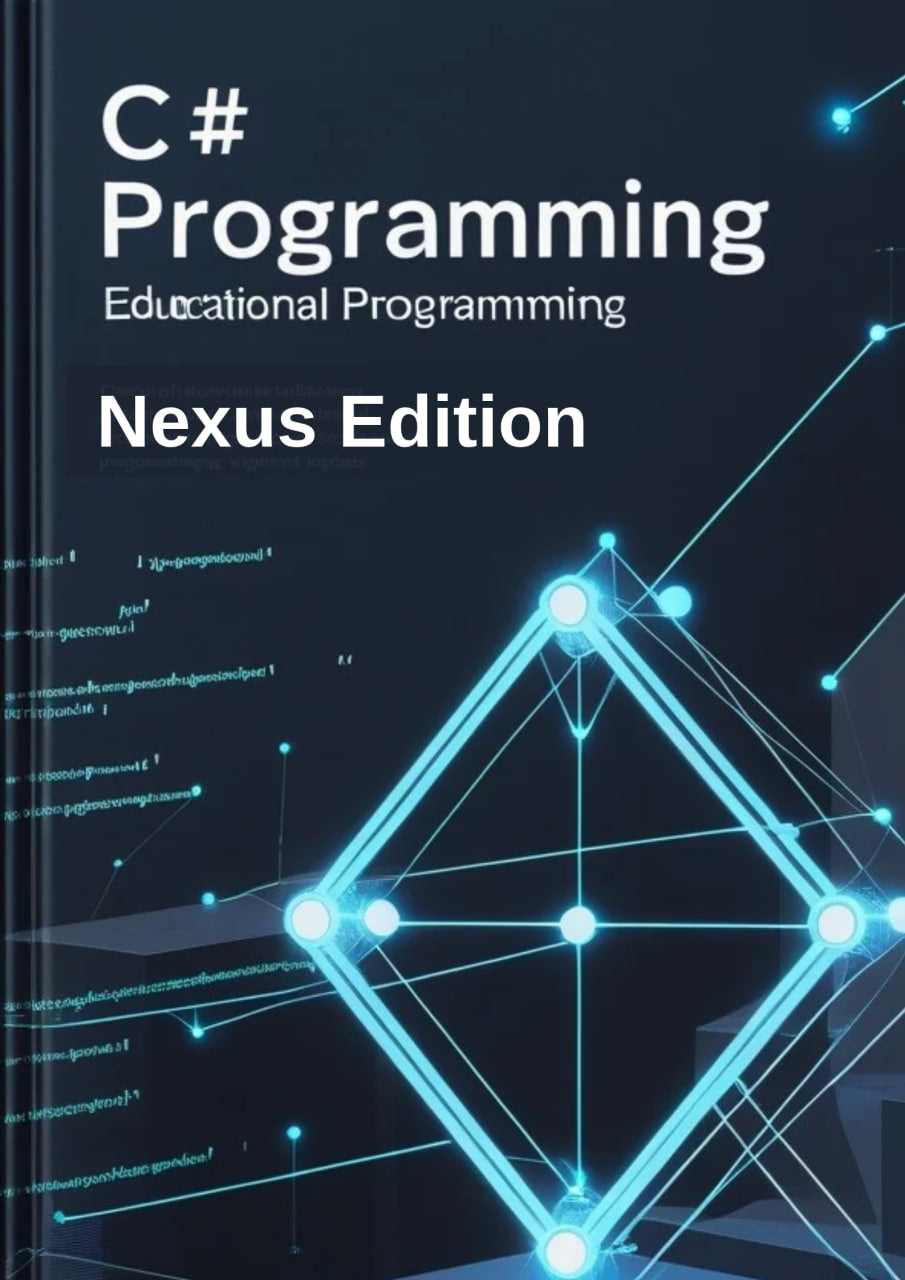
Nexus Edition
Nexus Edition
1. Problem Statement
When moving from small educational programs to more complex structures, developers need to organize code so that individual components have clearly defined responsibilities and relationships. Numerous interconnected classes can complicate modifications, behavior verification, and further development of programming logic. Without understanding architectural principles, developers may combine data handling, operational rules, and supporting functionality within the same classes. Additional challenges arise when organizing dependencies, configuring components, and examining whether they interact correctly. Studying more complex programming systems therefore requires an understanding of architectural layers and the distribution of responsibilities across different sections of code.
2. Solution
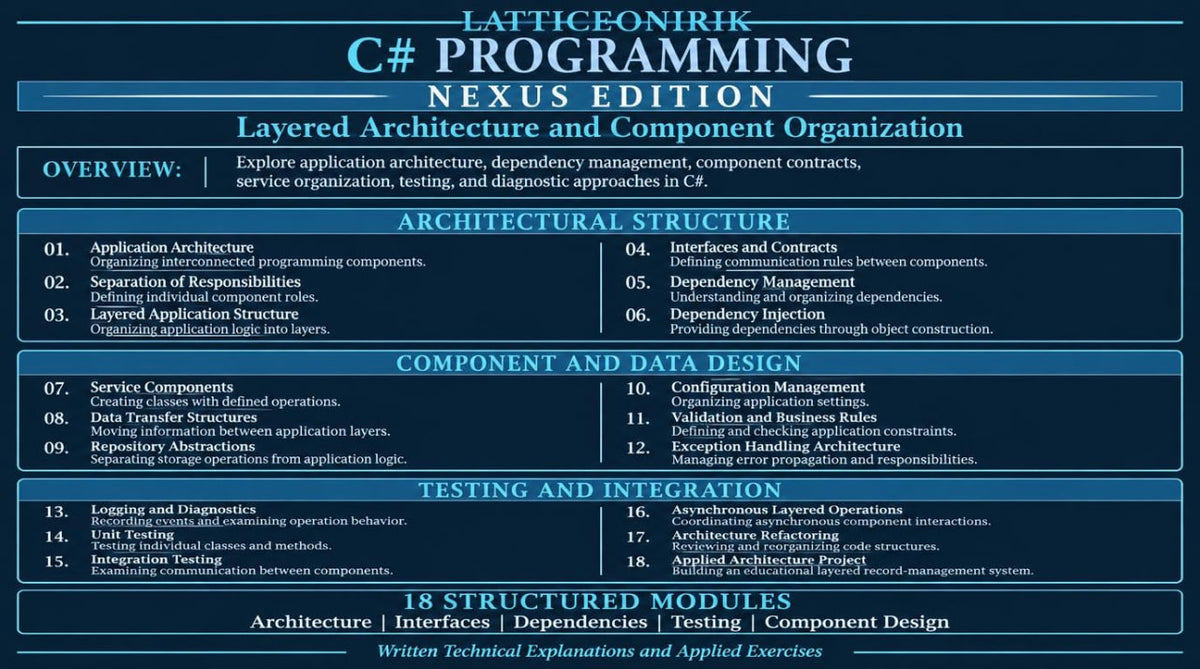
Nexus Edition presents a structured study of architectural approaches and the principles of building component-based C# applications. The materials explain responsibility distribution, interface usage, dependency management, and the organization of layered programming structures. Separate sections explore service components, configuration, data validation, and testing programming logic. Practical examples demonstrate how individual modules communicate, exchange information, and maintain understandable relationships. This progressive approach helps learners examine architectural decisions and the organization of programs containing several interconnected components.
3. What's Inside
Module 1: Introduction to Application Architecture
Explore application architecture, structural components, and the principles of organizing programming logic.
Module 2: Separation of Responsibilities
Study the distribution of responsibilities between classes, methods, and individual programming components.
Module 3: Layered Application Structure
Examine layered architecture and the organization of application logic, data handling, and component interactions.
Module 4: Interfaces and Component Contracts
Explore interfaces as a way of defining interaction rules between different application components.
Module 5: Dependency Management
Study programming dependencies and approaches to reducing direct coupling between components.
Module 6: Dependency Injection Principles
Learn how dependencies can be supplied through constructors and how object relationships are organized.
Module 7: Service-Oriented Components
Examine service classes used to perform defined operations and coordinate programming logic.
Module 8: Data Transfer Structures
Study data transfer structures and the separation of internal models from external representations.
Module 9: Repository Abstractions
Explore abstractions for storing, retrieving, and updating information within application structures.
Module 10: Configuration Management
Examine approaches to organizing configuration values and supplying settings to individual components.
Module 11: Validation and Business Rules
Study data validation rules and the placement of logical constraints within appropriate application components.
Module 12: Exception Handling Architecture
Explore exception-handling principles, error information propagation, and responsibility distribution.
Module 13: Logging and Diagnostic Information
Learn about diagnostic records, application event descriptions, and analyzing operation execution.
Module 14: Unit Testing Fundamentals
Study how individual methods and classes can be examined through isolated educational tests.
Module 15: Integration Testing Concepts
Explore testing interactions between multiple components and examining data exchange.
Module 16: Asynchronous Operations in Layered Programs
Examine asynchronous methods within layered applications and the coordination of operation results.
Module 17: Refactoring Application Structure
Study approaches to reviewing code organization, extracting repeated logic, and distributing responsibilities.
Module 18: Applied Architecture Project
Develop an educational record-management system with separate logic layers, services, interfaces, and data validation.
4. Who Is This For?
✅ Suitable if you:
- Already understand fundamental C# constructions and object-oriented programming.
- Are familiar with methods, classes, interfaces, and collections.
- Want to explore architectural approaches to application development.
- Are interested in responsibility distribution between components.
- Would like to understand dependency management mechanisms.
- Want to study layered application organization.
- Are interested in testing and diagnostic principles.
- Prefer written educational materials with practical examples.
❌ Not for you if you:
- Have not studied fundamental C# syntax.
- Are unfamiliar with classes, interfaces, and methods.
- Need an introductory programming course.
- Want materials focused exclusively on computational algorithms.
- Are interested only in graphical element construction.
- Expect individual instructor-led sessions rather than written educational resources.
5. What You'll Learn
- Application architecture fundamentals.
- Layered program organization.
- Responsibility distribution.
- Working with interfaces.
- Dependency management.
- Creating service components.
- Data transfer between layers.
- Configuration management.
- Data validation.
- Exception handling.
- Logging and diagnostics.
- Unit testing fundamentals.
- Component interaction testing.
- Code structure refactoring.
- Multi-component application organization.
6. Refund Terms
Nexus Edition is subject to the refund conditions described in the published Latticeonirik store policy. Refund requests submitted within 14 days are reviewed according to the store's published conditions, digital educational material delivery rules, and applicable legislation. We recommend reviewing the complete refund policy before placing an order.
7. Certificates
Nexus Edition — After completing Nexus Edition, you receive a certificate recognizing your study of connected C# applications, API communication, and service integration.
Self-paced learning overview
- 📄 Digital file available after purchase
- 📚 Long-term availability
- 🔒 Secure checkout
- 📅 Content updated in 2026
Couldn't load pickup availability
What Format Are Latticeonirik Courses Provided In?
What Format Are Latticeonirik Courses Provided In?
Our courses are presented as written PDF educational materials. They contain thematic sections, explanations of C# concepts, programming code examples, and practical exercises. Each course follows a structure appropriate to its subject matter and intended learning stage.
How Do the Courses in the Collection Differ?
How Do the Courses in the Collection Differ?
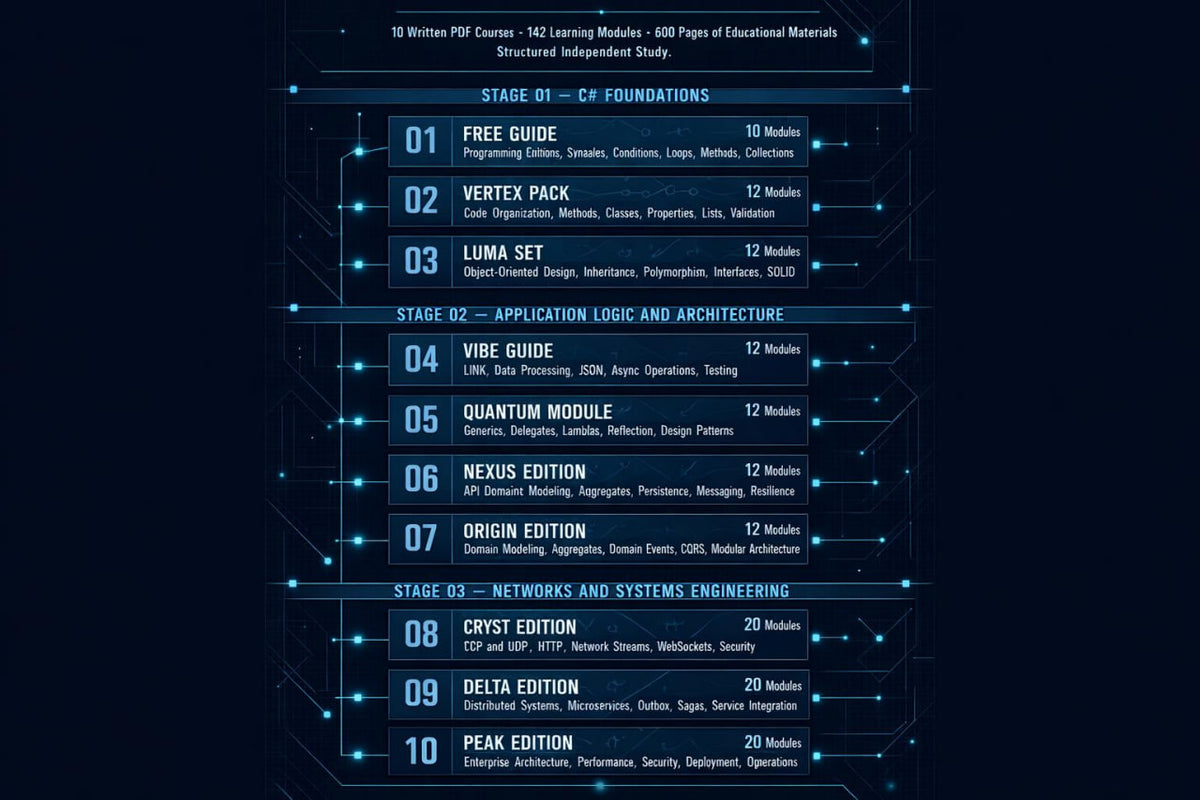
Each Latticeonirik course focuses on a distinct group of topics and learning activities. Introductory sections examine C# fundamentals, while subsequent materials gradually move toward data handling, object structures, programming logic, and code organization. The specific curriculum of each course is outlined in its description.
Share