Latticeonirik
Peak Edition
Peak Edition
1. Problem Statement
Developing multi-component applications requires combining architecture, data processing, network communication, and asynchronous execution within a unified structure. Even when individual C# mechanisms are understood, their combined operation can introduce complex dependencies and complicate the management of programming logic. Additional challenges arise when coordinating data formats, handling errors, managing resources, and examining interactions between components. Without a structured design approach, analyzing the consequences of architectural changes and maintaining understandable code organization can be difficult. Advanced C# study therefore benefits from examining how different technical mechanisms work together within an integrated application system.
2. Solution
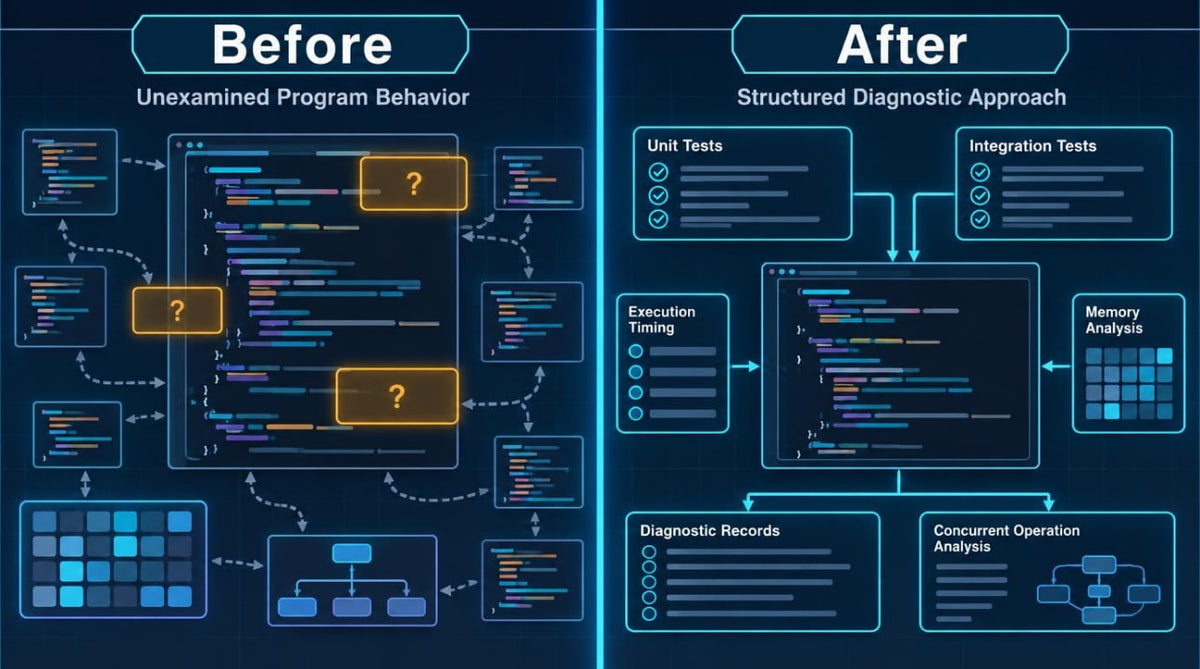
Peak Edition presents an integrated study of multi-component application design and development in C#. The materials explain architectural layer organization, contract definitions, dependency management, and the coordination of information-processing workflows. Separate sections examine asynchronous operations, network components, data persistence, testing, diagnostics, and error recovery. Practical exercises demonstrate the progressive construction of an educational system in which individual modules perform defined responsibilities and communicate through shared rules. This structure supports an understanding of the application design process, from initial modeling to integration testing and technical documentation.
3. What's Inside
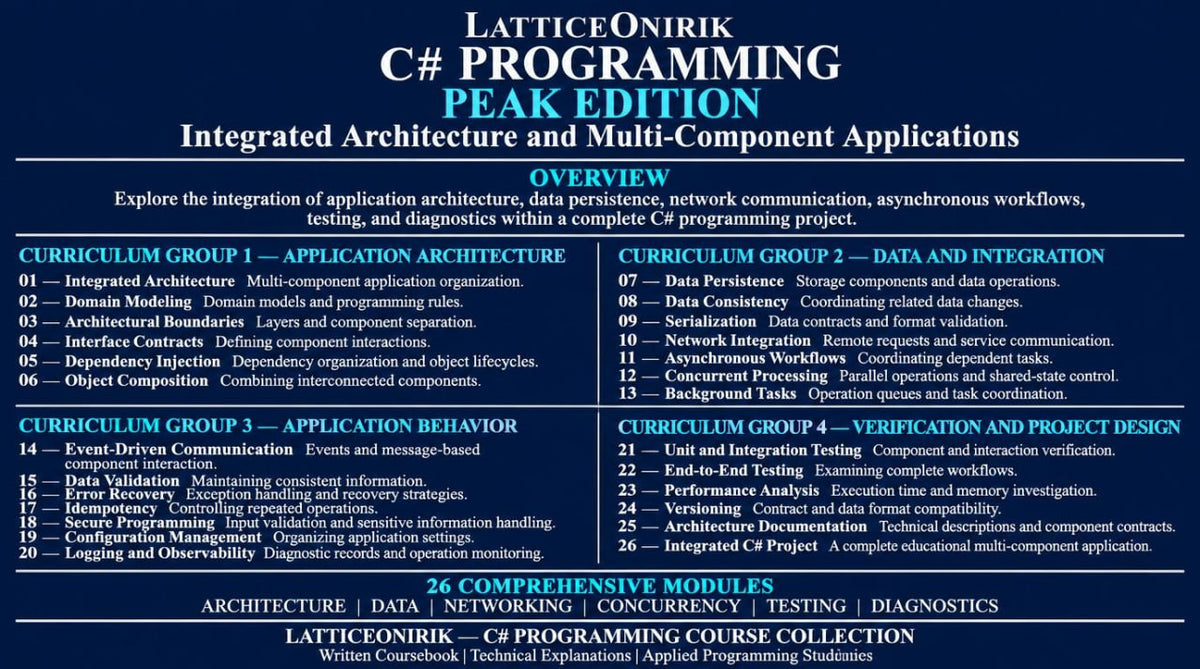
Module 1: Integrated C# Application Architecture
Explore integrated application design principles and interactions between architectural components.
Module 2: Domain Modeling and Business Logic
Study domain models, information-processing rules, and the organization of logic independently from supporting components.
Module 3: Architectural Layers and Boundaries
Examine architectural layers, their boundaries, and the organization of interactions between application sections.
Module 4: Interface Contracts and Abstractions
Study component contracts, interfaces, and the principles of separating implementations from their consumers.
Module 5: Dependency Injection Architecture
Explore dependency injection, object creation organization, and component lifecycle management.
Module 6: Advanced Object Composition
Examine object composition, responsibility distribution, and interconnected programming structures.
Module 7: Data Persistence Architecture
Study data storage components, model separation, and the management of reading and writing operations.
Module 8: Data Consistency and Transactions
Explore information consistency, grouping related changes, and transactional processing principles.
Module 9: Serialization and Data Contracts
Examine data exchange formats, object serialization, and verifying information against defined contracts.
Module 10: Network Service Integration
Study network component integration, request organization, and processing responses from remote services.
Module 11: Asynchronous Workflow Coordination
Explore asynchronous method coordination, task dependencies, and operation execution sequences.
Module 12: Concurrent Processing Architecture
Examine parallel data processing, shared-state management, and execution thread synchronization.
Module 13: Background Task Organization
Study background task organization, operation queues, and the controlled termination of long-running processes.
Module 14: Event-Driven Component Communication
Explore event-driven interactions, message transmission, and component separation through defined contracts.
Module 15: Validation and Data Integrity
Examine layered information validation, logical constraints, and maintaining consistent data states.
Module 16: Error Handling and Recovery Strategies
Study error classification, exception handling, operation retries, and process recovery.
Module 17: Idempotency and Operation Control
Explore idempotency, repeated request processing, and the prevention of unintended duplicate operations.
Module 18: Secure Programming Principles
Examine input validation, configuration information protection, and careful handling of sensitive values.
Module 19: Configuration and Environment Management
Study configuration parameters, distributing settings between components, and organizing different execution environments.
Module 20: Structured Logging and Observability
Explore diagnostic messages, operation identifiers, and monitoring the behavior of interconnected components.
Module 21: Unit and Integration Testing
Study unit and integration tests, test data preparation, and examining interactions between application components.
Module 22: End-to-End Workflow Testing
Examine complete operation scenarios, from receiving a request to generating a result.
Module 23: Performance and Memory Analysis
Study performance measurement, memory usage analysis, and the computational characteristics of applications.
Module 24: Versioning and Compatibility
Explore changes to application contracts, data structure versions, and compatibility between components.
Module 25: Architecture Documentation
Study technical descriptions, interaction diagrams, contract documentation, and explanations of architectural decisions.
Module 26: Integrated C# Application Project
Develop an educational multi-component application combining architectural layers, data processing, network communication, asynchronous operations, testing, and diagnostics.
4. Who Is This For?
✅ Suitable if you:
- Already understand foundational and advanced C# programming constructions.
- Are familiar with object-oriented programming principles.
- Understand basic architectural layers and interfaces.
- Want to explore the integration of individual programming components.
- Are interested in organizing asynchronous and parallel processes.
- Would like to study integrated approaches to data storage and processing.
- Want to combine testing, diagnostics, and architectural design.
- Are interested in constructing multi-component educational applications.
- Prefer written learning materials with detailed technical explanations.
❌ Not for you if you:
- Are beginning programming studies.
- Have not yet explored classes, interfaces, and collections.
- Need a short introduction to C# syntax.
- Are unfamiliar with foundational asynchronous programming concepts.
- Want materials focused exclusively on individual mathematical algorithms.
- Are interested only in creating simple single-purpose programs.
- Expect individual instructor-led sessions rather than independent written study materials.
5. What You'll Learn
- C# application architecture.
- Domain modeling.
- Interfaces and dependencies.
- Object composition.
- Data persistence.
- Network integration.
- Asynchronous workflows.
- Parallel processing.
- Event-driven communication.
- Data validation.
- Error handling.
- Secure programming.
- Component configuration.
- Application testing.
- Performance analysis.
- Architecture documentation.
- Programming module integration.
6. Refund Terms
Peak Edition is subject to the refund conditions described in the published Latticeonirik store policy.
Refund requests submitted within 14 days are reviewed according to the store's published rules, digital educational material delivery conditions, and applicable legislation.
We recommend reviewing the complete refund policy before placing an order.
7. Certificates
Peak Edition — Upon completing Peak Edition, you receive a Latticeonirik certificate recognizing your completion of the final course on enterprise C# architecture and software operations.
Self-paced learning overview
- 📄 Digital file available after purchase
- 📚 Long-term availability
- 🔒 Secure checkout
- 📅 Content updated in 2026
Couldn't load pickup availability
What Format Are Latticeonirik Courses Provided In?
What Format Are Latticeonirik Courses Provided In?
Our courses are presented as written PDF educational materials. They contain thematic sections, explanations of C# concepts, programming code examples, and practical exercises. Each course follows a structure appropriate to its subject matter and intended learning stage.
How Do the Courses in the Collection Differ?
How Do the Courses in the Collection Differ?
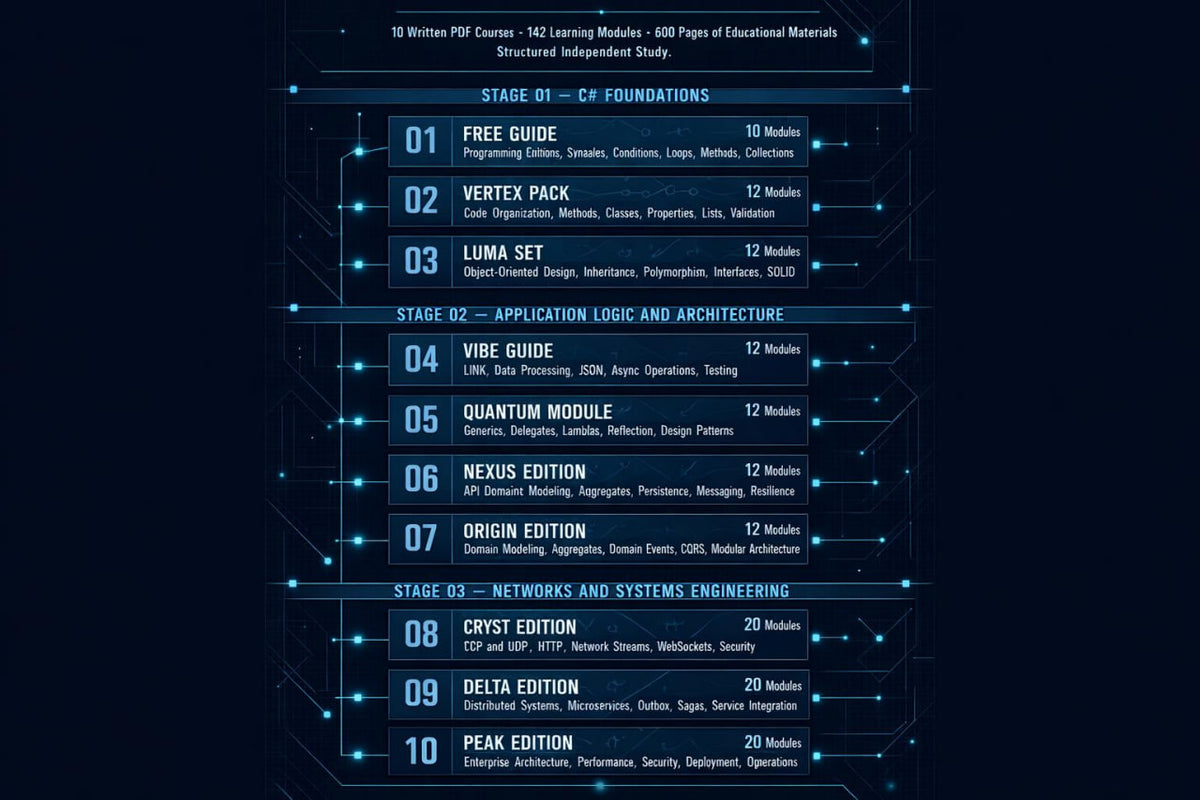
Each Latticeonirik course focuses on a distinct group of topics and learning activities. Introductory sections examine C# fundamentals, while subsequent materials gradually move toward data handling, object structures, programming logic, and code organization. The specific curriculum of each course is outlined in its description.
Share