Latticeonirik
Quantum Module
Quantum Module
1. Problem Statement
When developing programs that perform multiple operations, managing their execution order and interactions becomes an important consideration. Synchronous execution of long-running tasks can delay other instructions and affect program behavior. Additional challenges arise when working with asynchronous methods, parallel calculations, and shared data. Without understanding execution threads and synchronization mechanisms, analyzing errors caused by concurrent operations can be difficult. Further C# study therefore benefits from examining asynchronous programming, task management, and process coordination through structured technical examples.
2. Solution
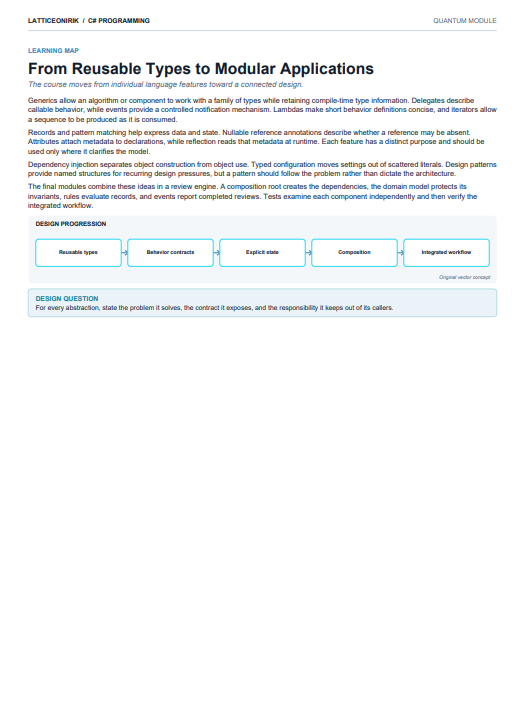
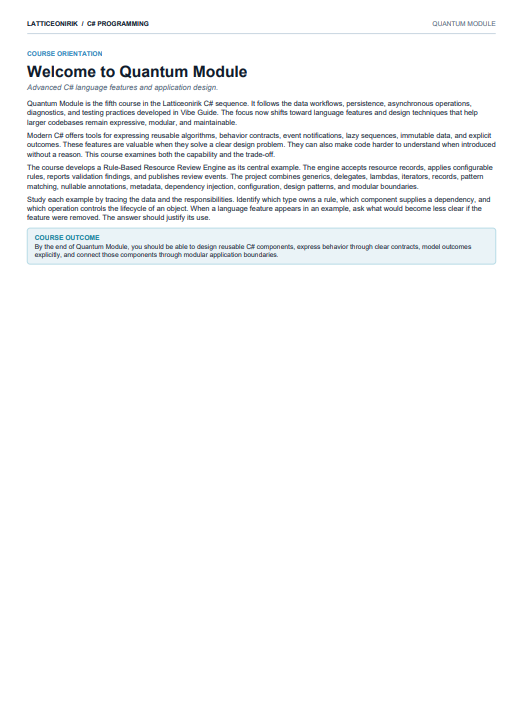
Quantum Module presents a systematic study of asynchronous programming and parallel execution in C#. The materials explain asynchronous methods, task objects, and mechanisms for awaiting operation results without blocking the calling thread. Separate sections examine operation cancellation, exception handling, shared-state synchronization, and the organized execution of parallel work. Practical examples demonstrate coordination between multiple tasks, controlling concurrent operation counts, and managing execution sequences. This structure supports an understanding of the distinctions between asynchronous execution and parallelism while introducing the relevant C# mechanisms.
3. What's Inside
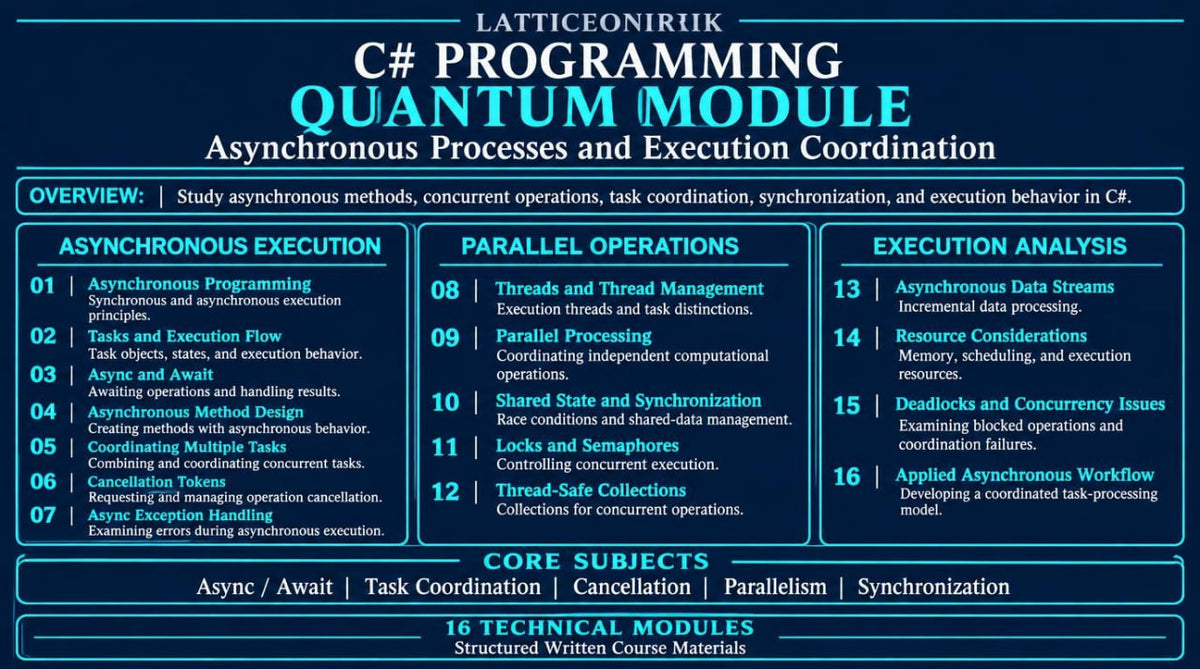
Module 1: Understanding Asynchronous Programming
Explore asynchronous execution, its purpose, and the differences between synchronous and asynchronous operations.
Module 2: Tasks and Execution Flow
Study task objects, their states, and the principles of organizing asynchronous execution.
Module 3: Async and Await
Examine the core asynchronous programming constructs and how operation results are awaited.
Module 4: Asynchronous Method Design
Learn how asynchronous methods are created, how results are returned, and how calls are organized.
Module 5: Coordinating Multiple Tasks
Explore running multiple tasks concurrently and coordinating their results.
Module 6: Cancellation Tokens
Study mechanisms for cancelling asynchronous operations and communicating cancellation requests.
Module 7: Exception Handling in Async Code
Examine how exceptions are handled during asynchronous task execution.
Module 8: Threads and Thread Management
Explore execution threads, their characteristics, and the distinctions between threads and asynchronous tasks.
Module 9: Parallel Processing Fundamentals
Study the parallel execution of independent operations and the distribution of computational work.
Module 10: Shared State and Synchronization
Examine shared data, race conditions, and foundational synchronization mechanisms.
Module 11: Locks and Semaphores
Explore coordination mechanisms for concurrent operations and controlling the number of active workers.
Module 12: Thread-Safe Collections
Study specialized collections designed for working with data during concurrent operations.
Module 13: Asynchronous Data Streams
Explore asynchronous sequences and incremental data processing techniques.
Module 14: Performance and Resource Considerations
Examine resource usage, task scheduling, and choosing appropriate execution approaches.
Module 15: Deadlocks and Common Concurrency Issues
Study deadlocks, race conditions, and common causes of incorrect process coordination.
Module 16: Applied Asynchronous Workflow
Develop an educational task-processing workflow featuring asynchronous execution, cancellation, and result coordination.
4. Who Is This For?
✅ Suitable if you:
- Already understand classes, methods, delegates, and events in C#.
- Want to study asynchronous programming principles.
- Are interested in managing multiple tasks.
- Would like to understand the differences between asynchronous and parallel execution.
- Want to explore operation cancellation mechanisms.
- Are interested in shared-data synchronization.
- Prefer written learning materials with code examples and practical exercises.
❌ Not for you if you:
- Have not studied fundamental C# syntax.
- Are unfamiliar with methods, classes, and foundational programming structures.
- Need introductory materials about variables, conditions, and loops.
- Want a course focused entirely on graphical interface construction.
- Are interested only in theoretical discussion without code examples.
- Expect individual instructor-led sessions.
5. What You'll Learn
- Asynchronous methods.
- Async and await constructs.
- Task creation and coordination.
- Operation cancellation.
- Asynchronous exception handling.
- Working with execution threads.
- Parallel processing fundamentals.
- Shared-data synchronization.
- Locks and semaphores.
- Thread-safe collections.
- Asynchronous sequences.
- Deadlock analysis.
- Asynchronous workflow organization.
6. Refund Terms
Quantum Module is subject to the refund conditions described in the published Latticeonirik store policy. Refund requests submitted within 14 days are reviewed according to the store's published terms, digital educational material delivery conditions, and applicable legislation. We recommend reviewing the complete refund policy before placing an order.
7. Certificates
Quantum Module — Upon completing Quantum Module, we provide a certificate documenting your completion of the course on advanced C# constructs and component organization.
Self-paced learning overview
- 📄 Digital file available after purchase
- 📚 Long-term availability
- 🔒 Secure checkout
- 📅 Content updated in 2026
Couldn't load pickup availability
What Format Are Latticeonirik Courses Provided In?
What Format Are Latticeonirik Courses Provided In?
Our courses are presented as written PDF educational materials. They contain thematic sections, explanations of C# concepts, programming code examples, and practical exercises. Each course follows a structure appropriate to its subject matter and intended learning stage.
How Do the Courses in the Collection Differ?
How Do the Courses in the Collection Differ?
Each Latticeonirik course focuses on a distinct group of topics and learning activities. Introductory sections examine C# fundamentals, while subsequent materials gradually move toward data handling, object structures, programming logic, and code organization. The specific curriculum of each course is outlined in its description.
Share